 Ultimate guide
Buying a Used Car From a Private Seller: Steps to Take
Last Updated: November 14, 2026
Quick Summary
Buying a used car from a private seller means you handle the due diligence a dealership would normally cover, so verify the VIN, title, and vehicle history before paying. Get a pre-purchase inspection, confirm any lien is released, and complete all paperwork before handing over money. Every risk a dealer would absorb now sits with you, so document everything.
- Match the VIN on the title, registration and dashboard plate before anything else.
- A missing title means the sale is not complete; do not pay in full against a promise.
- Confirm any lien payoff directly with the lienholder using a number you look up yourself.
- Meet at a bank branch during business hours and avoid untraceable payment methods like gift cards.
- Photograph the signed title, odometer, VIN plate and seller's ID before you leave.
Table of Contents
- How Buying From a Private Seller Differs From a Dealership
- What to Check When Buying a Used Car From a Private Seller
- What Paperwork Is Needed to Buy a Car From a Private Seller
- Questions to Ask a Private Car Seller Before You Pay
- Budgeting for the Full Cost: Price, Taxes, Fees and Insurance
- Paying Safely and Completing the Handover
- What to Do After Buying a Used Car From a Private Seller
- Red Flags to Walk Away From and Your Next Step
- Frequently Asked Questions
How Buying From a Private Seller Differs From a Dealership
When you buy a used car from a private seller, you are the one doing the due diligence that a dealership would normally handle. There is no sales desk arranging title paperwork, no finance office, and usually no warranty. The upside is that the negotiation is direct.
Expect the seller to be an individual, not a licensed business, which changes your legal footing. A dealer has to follow state consumer rules, disclose known damage and provide a buyers guide.
Negotiation also works differently. Private sellers often have no quota and no lot to clear, so a fair asking price is a starting point, not a fixed number. Many private sellers respond well to a clear, reasonable offer backed by specific findings from your inspection.
What to Check When Buying a Used Car From a Private Seller
Before you commit, verify the vehicle itself, its history and its condition. Matching the seller to the paperwork and the car to the listing takes only a few minutes and eliminates many common scams.
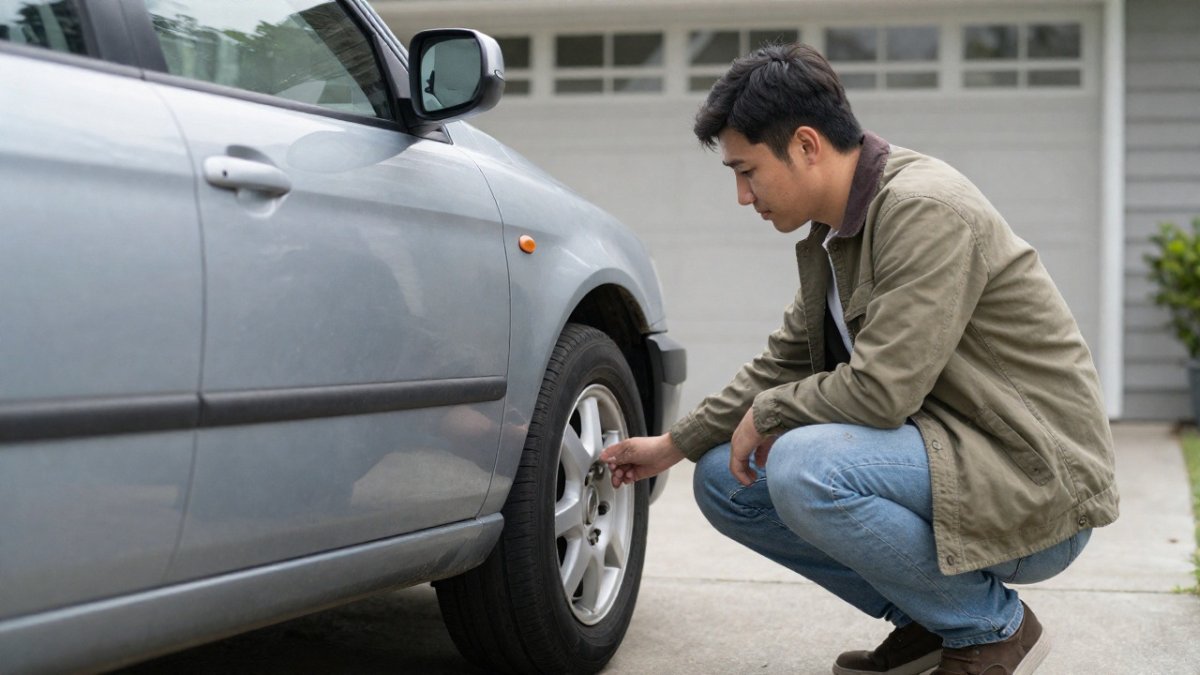
!A buyer in a casual jacket crouching beside a used sedan in a driveway, inspecting the tires and body panels in daylight
Verifying the VIN and Vehicle History Report
Start with the vehicle identification number (VIN). Compare the VIN on the title, the registration, and the plate stamped on the dashboard near the windshield. All three should match exactly. Any mismatch, or a VIN that has been scratched or re-stamped, is a serious warning sign.
Next, pull a vehicle history report. Many sellers will provide one, but run your own so you know it is current. A report can reveal a salvage or rebuilt title, odometer discrepancies, reported accidents, flood damage and open recalls. Vehicle history reports are available from several providers, which is a useful place to start if you are comparing options.
Inspecting the Car and Taking a Test Drive
Inspect the car in daylight and on dry ground. Look for uneven panel gaps, paint that does not match across panels, and overspray on rubber trim. Check tire wear for even tread across all four tires. Look under the car for fresh leaks, and check fluid levels and color with the engine cold.
On the test drive, drive at low and highway speeds, and listen for knocking, grinding or whining. Test the brakes in a straight line, and make sure the car does not pull to one side. Run the heater, air conditioning and all windows, lights and wipers. A short drive is not a full evaluation, which is why the pre-purchase inspection described below matters.
What Paperwork Is Needed to Buy a Car From a Private Seller
Paperwork is where private sales most often go wrong, and the title is the document that decides whether the deal is safe. The exact forms depend on your state, so confirm requirements with your state motor vehicle agency before you pay. What follows is the general packet plus decision rules for the title problems that stall real transactions.
The standard document packet
In general, you should expect to receive:
- The certificate of title, signed over by the seller, with the odometer reading recorded
- A bill of sale listing the VIN, date, price, and both parties' names and addresses
- A state odometer disclosure statement, where your state requires one
- A current registration and proof of insurance, if you will be driving the car home
- Any emissions or safety inspection certificate your state requires for transfer
- Maintenance and repair records, if the seller has them
- A lien release or payoff statement, if the title shows a lien
Confirm that the name on the title matches the seller's government-issued ID. Do not accept a title with a blank buyer section or a seller who wants to leave the sale date open.
Decision rules for title problems
A clean title is not a checkbox; it is a set of conditions you verify. Use these rules before you negotiate price.
Missing title. If the seller cannot produce a title, the sale is not complete. In most states, the seller must apply for a duplicate title before transferring ownership, and that process can take weeks.
Lien on the title. A lienholder must release the lien before the title can be transferred cleanly.
Branded title (salvage, rebuilt, flood, lemon). A branded title means the vehicle was declared a total loss or had a serious history.
Odometer discrepancy. If the title shows an odometer reading that does not match the car or the history report, or if the title is marked "not actual mileage," stop and verify.
Deadlines and state differences
Registration and title-transfer deadlines vary by state, and missing them can bring late fees or penalties. In general, you will need to transfer the title and register the car within a set number of days after the sale, and you may need a safety or emissions inspection first. Check your state motor vehicle agency's website for the exact forms, fees, and deadlines before you meet the seller, so you know what the seller must provide and what you must file.
Questions to Ask a Private Car Seller Before You Pay
The right questions surface problems early. Ask the seller directly, then check the answers against the title, the history report and your inspection.
- How long have you owned the car, and why are you selling it?
- Is the title in your name, and is there a loan or lien on it?
- Has the car been in an accident, flood, or fire? Do you have repair receipts?
- Are there any open recalls, warning lights, or problems you know about?
- Can I have a pre-purchase inspection at a mechanic of my choosing?
- Is the odometer reading accurate, and does it match the service records?
Pay close attention to hesitation or vague answers. A seller who refuses an independent inspection or pushes you to pay before you see the title is a reason to walk away.
Budgeting for the Full Cost: Price, Taxes, Fees and Insurance
The sticker price is only the start. Build a total budget before you negotiate so the final number does not surprise you.
Plan for these costs on top of the agreed price:
- Sales tax, which is charged in most states on private sales, though the rate and rules vary
- Title and registration fees, which are set by your state
- Insurance, which must be in place before you drive the car away
- A pre-purchase inspection, typically a modest fee from an independent mechanic
- Immediate repairs or maintenance, such as an oil change, new tires or brakes
Set aside a contingency for repairs in the first few months. Used vehicles often need some work soon after purchase, and having that cash ready keeps a minor fix from becoming a financial problem. If you need to borrow, compare lenders carefully before you commit to a rate.
Paying Safely and Completing the Handover
Payment and handover are where private-party deals fail most often, and the procedure matters more than the price. Treat the exchange as a sequence of verified steps, not a single moment of trust.
Step 1: Verify the seller and the title before money moves
Match the seller's government-issued photo ID to the name printed on the certificate of title. If the title lists a lienholder, call the lienholder using a number you look up independently, not one the seller provides, and confirm the payoff amount and the release process. A seller who cannot produce a title in their own name, or who asks you to pay a lienholder directly without a written payoff statement, is a reason to pause.
Watch out: A common scam involves a seller who claims the title is "being held by the bank" and asks for a deposit to release it. Never send money against a title you have not seen and a lien you have not independently confirmed.
Step 2: Choose a safe meeting place and payment method
Meet at a bank branch during business hours, ideally the seller's bank or your own, and complete the transaction inside or in the monitored parking area. Avoid meeting at a residence, a parking lot at night, or any location the seller insists on without explanation. Bring a second person if you can.
For payment, use a method that creates a record and can be verified on the spot:
- Cashier's check or money order: Confirm with the issuing bank that the instrument is valid before handing over the title. A cashier's check can be forged, so call the bank's published number rather than the one printed on the check.
- Bank-to-bank wire: Complete the wire at a branch with a teller, and confirm receipt in the seller's account before signing the title. Do not wire funds to an individual's account based on text or email instructions alone.
- Cash: If you pay cash, count it at the bank and get a receipt. Carrying large amounts of cash to an unknown location is a personal-safety risk.
Avoid gift cards, peer-to-peer apps with no buyer protection, and any request to overpay and refund the difference. Those are standard scam patterns, not negotiation tactics.
Step 3: Complete the paperwork at the same time as payment
Do not hand over funds until the seller has signed the title in front of you, filled in the odometer reading, and completed the bill of sale with the VIN, date, price, and both parties' names and addresses. Take photos of the signed title, the odometer, the VIN plate, and the seller's ID before you leave. If your state requires a lien release or a separate odometer disclosure, confirm it is signed and dated.
Watch out: A blank buyer section or an open sale date on the title lets someone else alter the document later. Insist that every field is completed before you pay.
Step 4: Exchange keys, plates, and possession
Get all keys, remotes, and any security codes at handover. Confirm what your state requires for license plates: some states require the seller to remove them, while others allow transfer. Ask the seller to cancel their registration and insurance on the vehicle as of the sale date, and get a signed statement that they have done so or will do so.
Keep the bill of sale, payment receipt, title photos, and inspection report together. If a dispute arises later, that packet is your evidence.
The article recommends verifying each step before money changes hands. The table below summarises the key checks at handover.
| Step | What to do | Key note |
|---|---|---|
| Verify seller and title | Match seller's photo ID to the title name | Confirm lien payoff with lienholder independently |
| Choose meeting place | Meet at a bank branch during business hours | Avoid residences and late-night lots |
| Choose payment method | Use cashier's check, bank wire or counted cash | Avoid gift cards and untraceable apps |
| Complete paperwork | Seller signs title and bill of sale in front of you | Do not pay until every field is filled |
| Document handover | Photograph title, odometer, VIN plate and ID | Keep receipts and the inspection report together |
What to Do After Buying a Used Car From a Private Seller
Within the deadline your state sets, transfer the title and register the car in your name. Visit your state motor vehicle agency or its website to file the application for title, pay the fees, and collect your new registration and plates. Missing this window can bring late fees or penalties.
Then insure the car, schedule an oil change, and have a mechanic review any issues found in the pre-purchase inspection. Keep the bill of sale, the inspection report and every receipt together in one folder. Those records protect you if a dispute comes up and help you when you eventually sell the car.
Red Flags to Walk Away From and Your Next Step
Walk away if the seller will not show you a title, insists on payment before the car is inspected, pressures you to decide immediately, or wants payment through a method you cannot trace. Also walk away if the VIN does not match the paperwork, if the odometer looks tampered with, or if the seller's story keeps changing.
If you prefer a seller who handles the paperwork and inspection for you, contact 4042 Motorsports in Garner, NC to ask questions or get help. Buying a used car privately can work well, but only when every document and detail checks out.
Frequently Asked Questions
Is it risky to buy a used car from a private seller?
It can be, but the risk is manageable with preparation. Private sales carry no dealer warranty and no guaranteed title check, so the buyer carries more of the verification work. Get a vehicle history report, have an independent mechanic perform a pre-purchase inspection, confirm the seller's name matches the title, and never pay before the title and bill of sale are in hand. Walking away from any seller who resists these steps is the simplest protection.
What paperwork do I need to buy a car from a private seller?
At minimum you need the signed certificate of title, with the seller's signature and an accurate odometer disclosure, plus a bill of sale listing the price, date, VIN and both parties' names. Requirements for registration and title transfer vary by state, so check with your state's motor vehicle agency for the exact forms, fees and deadlines. Some states also require a smog or emissions certificate before registration.
Is it cheaper to buy a car from a private seller?
Often the sticker price is lower because there is no dealer markup, but the final cost depends on the vehicle and the condition. Budget for sales tax, title and registration fees, a pre-purchase inspection, insurance and any repairs the inspection uncovers. Comparing the total out-the-door cost with dealer offers gives a fair picture of what you actually save.
Can I drive a car home after buying it from a private seller?
Usually yes, but only after the title has been signed over and you have proof of insurance covering the vehicle. Many states require temporary registration or a trip permit before the car can be driven on public roads. Confirm your state's rules before you leave with the car, and arrange insurance in advance so the drive home is legal and covered.
What should I check when buying a used car from a private seller?
Start with the VIN, which should match the title, the registration and the car itself. Review a vehicle history report for accidents, title brands, odometer problems and liens. Inspect the body, tires, fluids and interior, take a test drive on varied roads, and arrange a pre-purchase inspection by a mechanic you choose, not one the seller recommends.
What are the red flags when buying a used car from a private seller?
Watch for a seller who is not the name on the title, pressure to pay cash quickly, reluctance to allow an inspection, a missing or altered title, and a price far below market value with no clear reason. Requests to wire money or pay a deposit before seeing the car are a common scam. Any mismatched VIN or odometer reading is a reason to stop.
What should I do after buying a used car from a private seller?
Register the vehicle and transfer the title through your state motor vehicle agency within its deadline, paying any sales tax and fees. Update your insurance policy, keep the bill of sale and signed title in a safe place, and schedule an oil change and a basic maintenance check. Keeping maintenance records helps future resale value and gives you a baseline for the car's condition.